
Ranking · 301 combined test days · prices checked August 5, 2026
The 7 best budgeting apps for 2026
Real apps, ordinary transactions, and a drawback for every pick—because fit matters more than a universal winner.
Goodbudget is the best budgeting app of 2026 in our testing, scoring 4.8/5 for clear envelopes, useful free sharing, and strong value. EveryDollar ranks second at 4.5 for its quick zero-based setup, while YNAB is third at 4.4 for powerful hands-on planning. Automation seekers should consider Monarch Money or Quicken Simplifi.
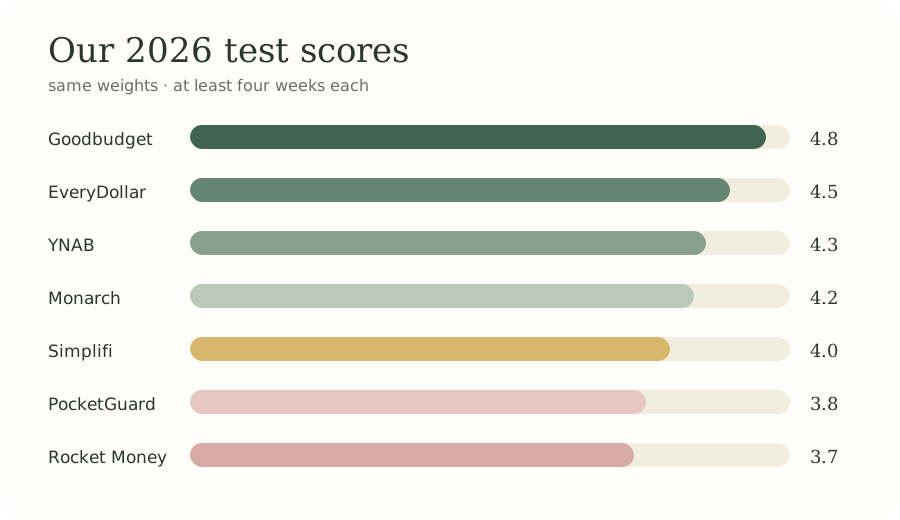
We tested each app daily for at least four weeks using checking, credit-card, cash, subscription, and irregular-expense scenarios. Scores combine planning clarity (30%), daily usability (25%), price and value (20%), automation (15%), and support/access (10%). Apps change, so all prices below are snapshots from August 5, 2026, before taxes and temporary promotions.
| Rank | App | Best for | Price checked Aug. 5 | Score |
|---|---|---|---|---|
| 1 | Goodbudget | Envelope planning | Free; $80/year Premium | 4.8 |
| 2 | EveryDollar | Quick zero-based setup | Free; $79.99/year Premium | 4.5 |
| 3 | YNAB | Detailed active budgeting | $14.99/month or $109/year | 4.4 |
| 4 | Monarch Money | Household overview | $14.99/month or $99.99/year | 4.3 |
| 5 | Quicken Simplifi | Automated cash flow | From $2.99/month, annual billing | 4.2 |
| 6 | PocketGuard | Safe-to-spend number | Free; $74.99/year Premium | 4.0 |
| 7 | Rocket Money | Subscription review | Free; Premium price varies | 3.9 |
1. Goodbudget — best overall
Score: 4.8/5. Goodbudget’s digital envelopes turn category limits into amounts you can consult before spending. The free tier has 10 regular and 10 goal envelopes, one account, two devices, and a year of history. Premium costs $10 monthly or $80 yearly and adds unlimited envelopes/accounts, more devices, longer history, and eligible US bank import.
Honest drawback: it asks for attention. Automation is Premium-only and institution support varies, while reports and investment tools are modest. That friction is worthwhile for planners who want active awareness, not for anyone expecting invisible tracking. Our 42-day Goodbudget review has the full score.
2. EveryDollar — best guided setup
Score: 4.5/5. EveryDollar makes zero-based planning unusually quick: enter income, assign jobs, and keep going until zero remains. Its free plan supports manual budgeting; the $79.99 annual Premium plan adds bank imports, paycheck planning, goals, insights, and group coaching. Transaction assignment on Premium was the smoothest part of our test.
Honest drawback: automatic tracking requires payment, and the Ramsey terminology and monthly reset can feel rigid. Goodbudget offers more generous free household use. See our EveryDollar review or the direct head-to-head.
3. YNAB — best for committed planners
Score: 4.4/5. YNAB gives every available dollar a job and encourages users to embrace true expenses and age their money. At $14.99 monthly or $109 annually, it is the priciest pure budget here, but its education, rules, targets, loan planner, and cross-device experience make a coherent system.
Honest drawback: there is a learning curve, and $109 a year is difficult to justify if you only want automatic categories. Reconciliation is part of the method, not an edge case. The official YNAB site lists a 34-day trial for direct sign-ups.
4. Monarch Money — best shared overview
Score: 4.3/5. Monarch combines budgets, recurring bills, goals, investments, and net worth in a polished household dashboard. Pricing was $14.99 monthly or $99.99 annually. Collaborator access and multiple data providers make it appealing when partners want one broad financial picture instead of a narrow spending plan.
Honest drawback: there is no permanent free tier, and broad coverage can produce more dashboard than a simple budget needs. Connection quality still depends on each institution. People who enjoy envelope boundaries may find its flexible category plan less decisive.
5. Quicken Simplifi — best cash-flow watch
Score: 4.2/5. Simplifi’s spending plan sets aside bills, subscriptions, goals, and planned spending, then shows what remains. The official offer displayed $2.99 per month billed annually for the first year on our check date; renewal and promotions may differ. Its watchlists are useful for monitoring a troublesome merchant or category without rebuilding the budget.
Honest drawback: promotional pricing complicates comparisons, and the spending-plan vocabulary takes adjustment. It is excellent at forecasting a connected-account month but less tactile than envelopes and less rigorous than YNAB’s method.
6. PocketGuard — best simple limit
Score: 4.0/5. PocketGuard’s “In My Pocket” figure subtracts bills, goals, and necessities to estimate what is safe to spend. A free plan is available; PocketGuard Plus was listed at $12.99 monthly or $74.99 annually, with a $99.99 lifetime option shown during our check. The compact answer helps people overwhelmed by category detail.
Honest drawback: a single safe-to-spend number hides assumptions, so incorrect bills or delayed transactions can make it falsely reassuring. Premium pricing feels high beside richer annual plans, and bank coverage needs testing during the trial window.
7. Rocket Money — best subscription checkup
Score: 3.9/5. Rocket Money is strong at finding recurring charges, presenting bills, and starting cancellation workflows. Core tracking is free. Premium uses a choose-your-price structure that commonly displays a monthly range, with some lower selections billed annually; the exact offer appeared account-dependent on August 5.
Honest drawback: its budgeting layer is not as method-driven as our top three, and bill-negotiation services may charge a share of savings under separate terms. Use it to audit subscriptions, then decide whether the broader Premium bundle earns a permanent place.
How to choose from the seven
Pick a method before a feature list. Choose Goodbudget for visible envelopes, EveryDollar for a brisk monthly plan, or YNAB for a deeper budgeting practice. Choose Monarch for a shared big picture, Simplifi for forward-looking cash flow, PocketGuard for one practical limit, or Rocket Money for recurring-charge cleanup. Our eight-question guide turns those preferences into a short decision.
Test with your messiest normal week, not a fresh demo budget. Import or enter transactions, wait for a refund, split one purchase, and reconcile a statement. Keep the app that reduces uncertainty after four weeks. A lower-ranked tool that matches your habits is better than our winner sitting unopened.
About this ranking: Mara and Theo used each app for at least four weeks; Iris Wren checked public prices and plan claims. ThriftWren bought subscriptions, accepts no sponsored placement, and does not use affiliate links.