
Comparison · 77 combined test days · updated August 5, 2026
Goodbudget vs. EveryDollar: two good plans, one narrow winner
Both ask every dollar to do a job. One feels like labeled jars; the other feels like a crisp monthly worksheet.
Goodbudget beats EveryDollar by 4.8 to 4.5 in our 2026 comparison. Its useful free sharing, flexible envelopes, and lower-friction household planning win narrowly. EveryDollar is the better choice for a beginner wanting the fastest guided zero-based setup, especially if paying $79.99 yearly for bank imports feels worthwhile.
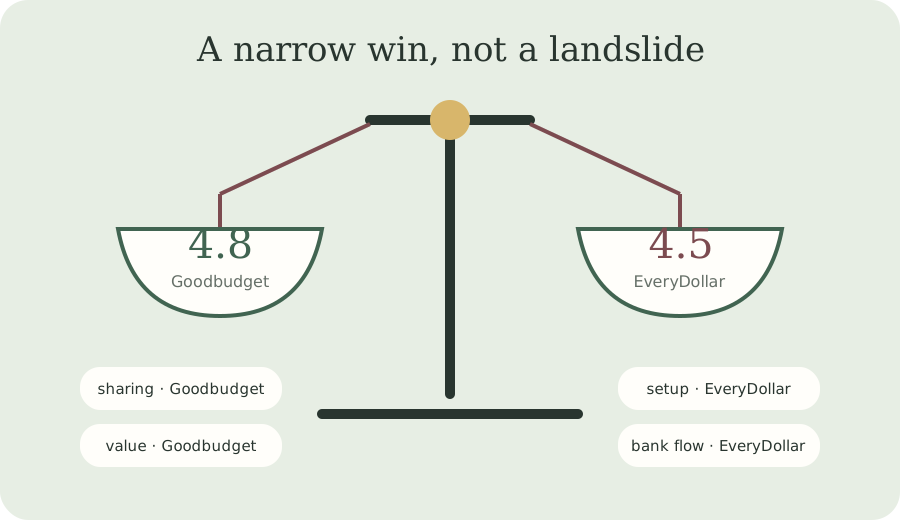
This is not a comparison between a good app and a bad one. We used Goodbudget for 42 days and EveryDollar for 35, recording the same kinds of rent, groceries, transport, subscriptions, and irregular costs. Both made the month easier to understand. The difference is where each places the work: Goodbudget asks you to maintain envelopes; EveryDollar asks you to rebuild a clean monthly plan.
| Category | Goodbudget | EveryDollar | Winner |
|---|---|---|---|
| Overall score | 4.8/5 | 4.5/5 | Goodbudget |
| Free plan | 10 regular + 10 goal envelopes; 2 devices | Full manual monthly budget | Goodbudget |
| Paid price | $10/month or $80/year | $79.99/year | Tie |
| Bank import | Premium; eligible US banks | Premium | EveryDollar |
| Planning style | Envelope budgeting | Guided zero-based budget | Tie by preference |
| Couples | 2 free or 5 paid devices | Shared household login | Goodbudget |
| Setup speed | About 25 minutes | About 15 minutes | EveryDollar |
| Reports | Spending by envelope/income | Planned vs. spent | Tie |
Planning: jars versus worksheet
Goodbudget turns categories into envelopes with current balances. Put $400 into Groceries, spend $62, and $338 remains visibly available. That model is excellent for decisions during the month because the limit travels with you. It also accommodates irregular expenses through annual or goal envelopes. The tradeoff is setup: deciding how many envelopes to create and how to fill them takes thought.
EveryDollar begins with expected income and a structured category list, then prompts you to assign every dollar until the remainder is zero. It is faster for a first-time budget and the arithmetic is always apparent. Its calendar resets the conversation each month, which is motivating for some people and repetitive for others. EveryDollar wins setup speed; Goodbudget wins mid-month visibility.
Price: almost identical, value less so
Prices checked August 5, 2026 put Goodbudget Premium at $10 monthly or $80 annually. EveryDollar Premium was $79.99 annually after a 14-day trial, with offers subject to change. The sticker difference is one cent per year, so price alone cannot decide this. The free tiers reveal more: Goodbudget permits two devices and a constrained but meaningful envelope system, while EveryDollar gives a full manual budget but reserves connected-bank imports for Premium.
A solo planner can use either free indefinitely. For a couple, Goodbudget’s free device allowance and synchronized envelope balances are more naturally collaborative. For a high-volume card spender, EveryDollar Premium’s drag-and-drop import flow felt faster in our test. Read the detailed Goodbudget review and EveryDollar review for the complete plan limits.
Transactions and bank connections
Goodbudget centers manual entry even though Premium offers automatic import for eligible US institutions. Logging at the till keeps balances current, but a backlog becomes homework. EveryDollar’s free plan has the same manual burden; its Premium import presents cleared bank transactions for quick category assignment. Theo processed a typical batch in under ten minutes twice a week.
No aggregator connection is perfectly immediate. A restaurant charge may remain pending, disappear, then clear at a slightly different amount. Neither app should be treated as a live bank balance. Goodbudget is better if manual attention is the behavior you want. EveryDollar Premium is better if repetitive typing is what made you abandon previous budgets.
Couples and small households
Goodbudget is our winner for couples. Both people see one set of envelopes, the free plan covers two devices, and spending decisions reduce to a shared available amount. Premium expands access to five devices. It is simple rather than granular: there are no sophisticated member permissions, so trust and a weekly conversation still matter.
EveryDollar can be shared with a household login and produces a clean joint plan. The experience is workable, but it feels like two people editing one worksheet rather than two people carrying a shared set of envelopes. Couples already using Ramsey’s debt framework may prefer its language and coaching. Everyone else should test both free plans before importing a bank connection.
Reports, goals, and philosophy
Neither is a full financial command center. Goodbudget reports income versus spending and spending by envelope. EveryDollar compares planned and actual spending, with Premium adding insights and goal tools. Neither replaces an investment tracker, tax planner, or detailed retirement model. If net worth is the primary question, our 2026 app ranking includes more suitable options.
The philosophical distinction is more useful than a feature count. Goodbudget asks, “How much is left in this purpose?” EveryDollar asks, “Did you give all income a job this month?” Those questions overlap, but one may make more sense in your head. Our choosing guide helps identify which kind of prompt you will actually answer.
Final call
Goodbudget wins 4.8 to 4.5 because its envelope balances are excellent at the moment of spending, and its free household use is unusually generous. Choose EveryDollar instead if guided setup, a conventional monthly worksheet, and fast Premium transaction assignment matter most. Whichever you pick, use the free version through one complete pay cycle before paying; a budget’s best feature is surviving an ordinary Tuesday.
Mara Bell and Theo Finch tested both apps independently, reconciled their logs, and scored the same five weighted categories. ThriftWren bought access and accepts no sponsored placements.