
Review · tested 42 days · prices checked August 5, 2026
Goodbudget review: envelopes that earn their keep
A patient, hands-on budget for people who would rather make a plan than admire another spending chart.
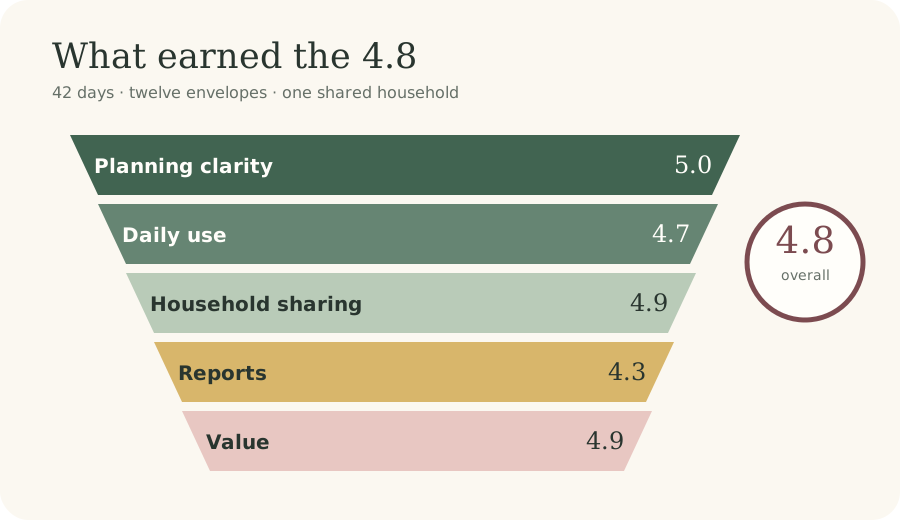
Verdict: Goodbudget is our best budgeting app of 2026, scoring 4.8/5 after a 42-day test. Its digital envelopes make limits unusually clear, sharing works well, and the free tier is genuinely usable. Choose something else if automatic bank syncing, investment tracking, or glossy forecasting matters more than deliberate planning.
I tested Goodbudget through two freelance invoice cycles, a rent payment, shared grocery shops, and a weekend trip. I used twelve envelopes, entered most purchases manually, and reconciled balances every Sunday at our very small kitchen table. That matters: Goodbudget is not a passive financial dashboard. It is a lightweight routine that makes you decide where money belongs.
What worked
- Envelope balances answer “can I spend this?” quickly.
- Free plan is enough to learn the method.
- Shared household budget stays easy to read.
- Web and mobile versions remain consistent.
What grated
- Useful automation requires Premium and US bank eligibility.
- Manual entry becomes tiring after busy weekends.
- No investment or net-worth depth.
- Reports are sensible, not sophisticated.
How the envelope method feels in practice
On payday, Goodbudget has you fill digital envelopes such as Rent, Groceries, Transit, and Gifts. A $360 grocery envelope is not merely a retrospective category: it is the amount available for the month. When I logged a $54.20 shop, the envelope fell to $305.80. That tiny change in framing made the app more actionable than trackers that announce overspending afterward.
The method also handled uneven income better than expected. I built the next month from money already received, then held a “Next month” envelope rather than budgeting an invoice before it arrived. Goodbudget does not magically smooth freelance work, but it supports the conservative habit of assigning real money. Our zero-based budgeting definition explains the underlying idea.
Price and plan limits
As listed on Goodbudget’s official site on August 5, 2026, the free plan costs $0 and includes 10 regular envelopes, 10 annual or goal envelopes, one account, two devices, and one year of history. Premium is $10 monthly or $80 annually—equivalent to about $6.67 per month when paid yearly—with unlimited envelopes and accounts, five devices, seven years of history, automatic bank sync for eligible US banks, and email support.
The free tier is the honest starting point. Ten monthly envelopes can cover a simple solo budget, while goal envelopes hold irregular costs such as insurance and repairs. Premium earns its price for families needing more accounts or US users who value transaction import. Paying $80 solely for prettier reports would be hard to defend because those reports remain basic.
| Category | Weight | Score | Weighted points |
|---|---|---|---|
| Planning clarity | 30% | 5.0/5 | 1.50 |
| Daily usability | 25% | 4.7/5 | 1.18 |
| Price and value | 20% | 4.9/5 | 0.98 |
| Automation | 15% | 4.2/5 | 0.63 |
| Support and access | 10% | 4.8/5 | 0.48 |
| Total | 100% | 4.77/5 | 4.77 → 4.8 |
Sharing, sync, and the weekly rhythm
Goodbudget is strongest when two people need one source of truth. A purchase entered on my phone appeared quickly on the second test device, and the envelope balance—not a dense account ledger—was what mattered. Two devices on the free plan cover many couples; Premium’s five-device allowance suits a household with phones, a tablet, and a shared computer.
Automatic bank sync is less universal. It is a Premium feature for supported US institutions, so international users and unsupported banks will use manual entry or imported files. Manual entry took roughly four minutes per day during my test and ten minutes after a travel weekend. That attention improved awareness, but it is still labor. Our later six-week Goodbudget versus notebook test measures that work directly. Read our app selection guide before calling friction a virtue.
Who should choose Goodbudget?
Choose it if you like visible spending limits, plan with a partner, or want a useful free budget without ads. It is especially good for cash-style thinkers who naturally divide money into purposes. Avoid it if you need investment aggregation, deep cash-flow forecasts, or hands-off categorization. In our Goodbudget versus EveryDollar comparison, its gentler pricing and household sharing produce a narrow win.
Goodbudget FAQ
Is Goodbudget free in 2026?
Yes. The free plan includes 10 regular envelopes, 10 annual or goal envelopes, one account, two devices, and one year of history. Premium is listed at $10 per month or $80 per year as checked August 5, 2026, adding unlimited envelopes and accounts, five devices, seven years of history, and email support.
Does Goodbudget connect to bank accounts?
Premium subscribers in the United States can connect eligible banks for automatic transaction import. Availability still varies by institution, and manual entry or file import remains central. That deliberate workflow helps attentive planners, but people wanting effortless, instant categorization may prefer a more automation-led app.
Is Goodbudget good for couples?
Yes, particularly for couples who want to see the same envelope balances before spending. The free plan supports two devices and Premium supports five. It works best when both people agree on envelope names and hold a short weekly check-in; it does not replace the conversation with forecasts or investment dashboards.
What is Goodbudget’s biggest drawback?
Goodbudget asks for more participation than automatic trackers. Bank sync is Premium-only and US-focused, transaction cleanup takes time, and its reports look functional rather than polished. If you want an app to quietly classify everything in the background, that friction can outweigh the clarity of envelopes.
Mara Bell edits ThriftWren and budgets around uneven freelance invoices. She used Goodbudget daily for 42 days; the publication bought Premium and received no payment or editorial input from the company.